The Completion and Compliance Layer for banks and credit unions

Wherever your front door is,your back office should finish the job.

Disputes, account openings, wires and loan conditions still move by email and re-keying while Reg E and Reg B clocks and Fedwire cutoffs run. Callvu runs each one from the request to the core, and enforces every control at runtime, while the work happens. Built for large banks running high volumes across many lines of business, and for community banks and credit unions running lean. Live in weeks.

Banking rules, preloaded

  • GLBA
  • Reg E
  • Reg CC
  • BSA and CDD

Four lines of business

Where it breaks today,and where to start

Deposits and account servicing

Where it breaks today

  1. Disputes arrive by phone, branch, app and email, and sit in separate inboxes after the Reg E clock has started.
  2. Hold decisions are made at the teller line and keyed into the core a second time.
  3. Business accounts collect entity and beneficial owner documents over email, then re-key them into the core and BSA systems.

What Callvu enforces, on the record

  1. One dispute intake from every door, with the Reg E clock started and tracked from the first contact.
  2. Required documents and owner details collected before the case moves, then written to the core.
  3. Provisional credit and notices triggered on time, with every step in the Audit Trace.
  4. Written to your system of record, with the Decision Trace and Audit Trace

Where a typical bank or credit union struggles most:

  • Debit card and EFT disputesReg E, 10 business days
  • Business account opening with beneficial ownersBSA, CDD Rule
  • Large-deposit and new-account holdsReg CC

Proof: Banca Transilvania moved 73% of its inbound call traffic to digital self-service

Talk to a banking expert

Commercial and consumer lending

Where it breaks today

  1. Incomplete applications stall because nobody owns chasing the borrower.
  2. Financials, insurance certificates and covenant items are tracked in spreadsheets and email reminders.
  3. Loan data is re-keyed from the application into the origination system, then into the core.

What Callvu enforces, on the record

  1. Missing items requested from the borrower automatically, on the Reg B 30-day clock.
  2. Approvals routed to the lender, credit and committee, each decision with a named owner.
  3. Post-close exceptions chased until cleared, and written back to the loan system.
  4. Written to your system of record, with the Decision Trace and Audit Trace

Where a typical bank or credit union struggles most:

  • Incomplete applications and adverse actionReg B, 30 days
  • Post-close documents and covenant exceptions
  • Commercial loan approval routing

Proof: Community Bank of Mississippi, loan operations and credit administration; Bank Leumi, every loan application and servicing workflow digitized in six months, with loan decisions more than a week faster

Talk to a banking expert

Payments and wires

Where it breaks today

  1. Wire requests arrive by phone, email and fax, so callback and dual control depend on people remembering.
  2. Sanctions screening and approvals happen outside the core and are tracked on paper.
  3. Late-day requests miss the cutoff while they wait for an approver.

What Callvu enforces, on the record

  1. No wire moves without callback verification and a second approver.
  2. Screening and approval steps inside one process, timed against the cutoff.
  3. Every release on the record, ready for the examiner.
  4. Written to your system of record, with the Decision Trace and Audit Trace

Where a typical bank or credit union struggles most:

  • Outgoing customer wiresFedwire cutoff 6:45 p.m. ET
  • Treasury and ACH origination onboarding
  • Wire recall and fraud claims

Proof: Cache Valley Bank runs its Fedwire wire transfers on Callvu

Talk to a banking expert

Back office and operations

Where it breaks today

  1. Access requests and terminations run by email, and review evidence is assembled for the exam after the fact.
  2. HR changes are entered into several systems by hand.
  3. Vendor due diligence documents are collected one email at a time.

What Callvu enforces, on the record

  1. Every access change approved, provisioned and certified in one flow.
  2. One HR request written to every system it touches.
  3. The exam evidence produced as the work happens, not rebuilt later.
  4. Written to your system of record, with the Decision Trace and Audit Trace

Where a typical bank or credit union struggles most:

  • User access provisioning, removal and certification
  • HR onboarding and changes
  • Vendor due diligence

Proof: Community Bank of Mississippi, IT, information security and HR processes

Talk to a banking expert

“Callvu helped us migrate 73% of our inbound call traffic to digital self-service. They transformed our customer experience in ways we didn't think were possible. That's no easy task when you're dealing with everything that arises in consumer banking.”

Anca Radu, Digital Project Manager, Banca Transilvania

See it under GLBA

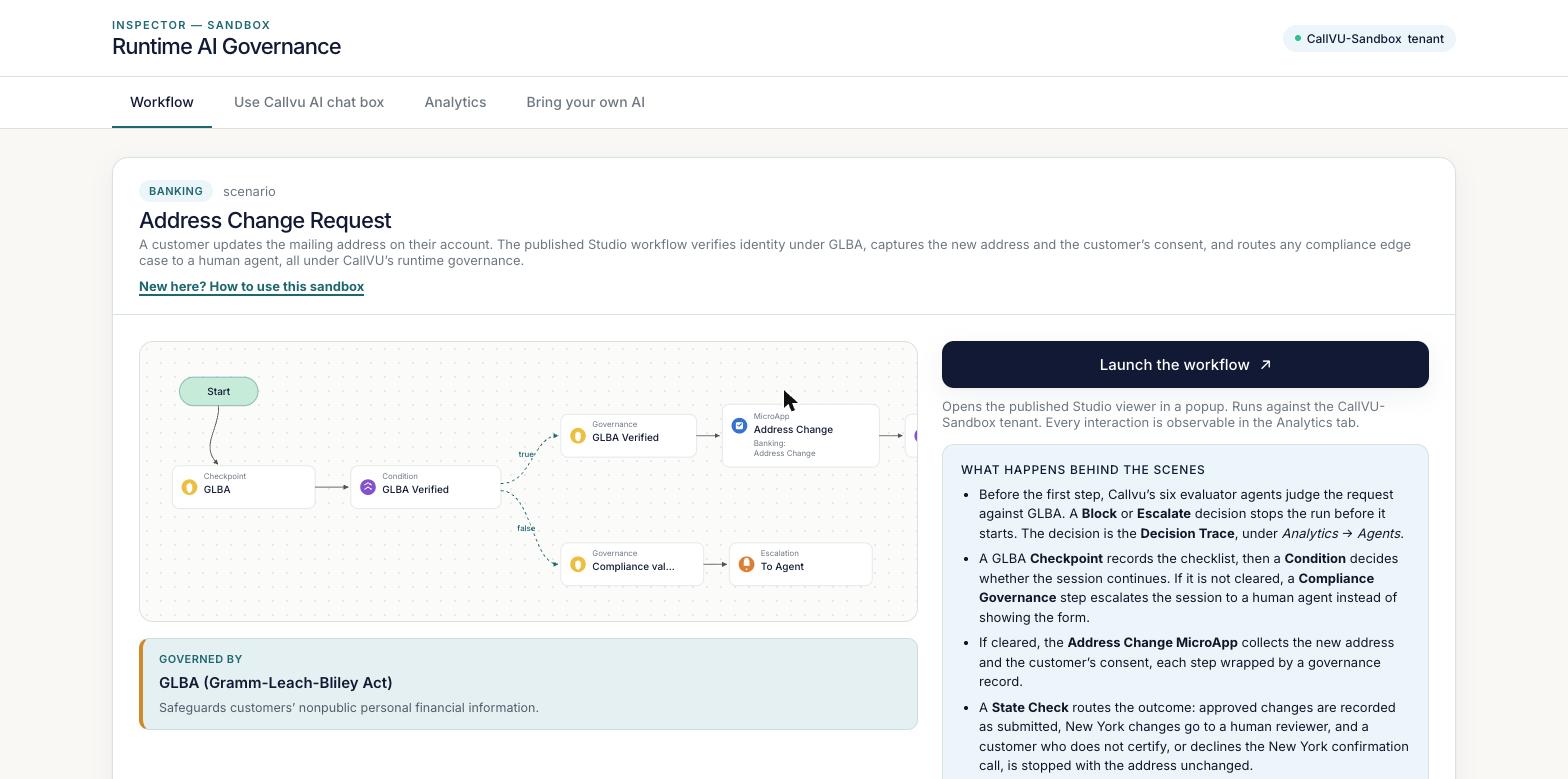
A banking address change, governed from the first step

The six evaluators judge the request against GLBA before it starts. A checkpoint records the checklist. If identity is not cleared, the Completion Orchestrator routes the case to a person instead of continuing. Every step lands in the Decision Trace and the Audit Trace.

Sandbox: banking address change workflow under GLBA, with checkpoint, condition and escalation

Integrations

Runs on the systems your bank already has

Core, digital banking, loan origination, CRM, contact center and messaging, plus your GRC system. By API and webhook, built to what you run. The list keeps growing.

See all integrations
  • LaserPro

Calculator

What's your number?

What unfinished and non-compliant work costs banking and credit unions a year. Seven questions, about two minutes.

Calculate

Bring your messiest back-office process

We build it, train your team and stay with you through launch and the ongoing management of your processes. You are live in weeks, with the evidence your examiners ask for.

Talk to a banking expert