The Completion and Compliance Layer for insurers

Intake is fast now.Finishing is not.

Apps, chatbots and connected cars sped up the first notice. Claims, pre-authorizations, assistance dispatch and beneficiary changes still move by email, phone and re-keying after it. Callvu runs each one from the first notice to policy admin and claims, and enforces every control at runtime, while the work happens. For P&C, health and life carriers. Live in weeks.

Insurance rules, preloaded

  • NAIC Model #668
  • Unfair claims settlement

At Phoenix Insurance

Also on Callvu: Aflac

Four lines of business

Where it breaks today,and where to start

Auto

Where it breaks today

  1. Claims arrive incomplete at first notice: no police report, no medical consent, the wrong claim type. They are rebuilt by phone.
  2. Other insurers, passengers and repair shops are chased by email, on no measured clock.
  3. Chatbots and apps take the claim, but nothing enforces what must happen before it moves.

What Callvu enforces, on the record

  1. One claim from any door: connected car, app, agent, chatbot or your own AI start the same governed process.
  2. No injury claim moves without medical consent. Customers see only the questions that apply.
  3. Claims land complete in the claims core, with a work item, skill and due date for adjusters. Third-party requests go out on a clock.
  4. Written to your system of record, with the Decision Trace and Audit Trace

Where a typical insurer struggles most:

  • Injury claims at first notice
  • Third-party and subrogation requests
  • Repair estimate approval

Proof: Phoenix Insurance put 100+ processes live in under 3 months, with 40% fewer agent-led calls

Talk to an insurance expert

Major medical

Where it breaks today

  1. A missing medical report or invoice stops review until someone calls the hospital.
  2. The provider portal, the agent, email and phone each build a different file.
  3. Who reviewed what, against which policy terms and when, lives in emails and notes.

What Callvu enforces, on the record

  1. One intake from every door: provider portal, agent, member link or AI.
  2. The request type sets the required documents and consents, so no incomplete file reaches review. Missing items are chased from the hospital, doctor or member, on a clock.
  3. People make the medical call. Callvu records who decided, why and when, and writes the status to the core.
  4. Written to your system of record, with the Decision Trace and Audit Trace

Where a typical insurer struggles most:

  • Reimbursement claims
  • Scheduled-procedure pre-authorization
  • Hospital file completion

Proof: The Ministry of Health hospital network runs 23 hospitals on Callvu, with 3x faster procedure approvals and 78% faster patient consent

Talk to an insurance expert

Home and assistance

Where it breaks today

  1. Whoever answers decides emergency or claim, often sending a supplier before cover is checked.
  2. Arrival, work done and customer acceptance are confirmed by phone, if at all.
  3. Photos, location and estimates sit across chat, email and the supplier's own system.

What Callvu enforces, on the record

  1. Each request is typed as assistance or claim, and coverage is checked before dispatch.
  2. Location, photos and damage are captured once. Suppliers accept the job and post their estimate and completion, and overdue steps escalate.
  3. A case closes only when the customer confirms the service, with every step and approval on the record.
  4. Written to your system of record, with the Decision Trace and Audit Trace

Where a typical insurer struggles most:

  • Emergency assistance dispatch
  • Water damage claims
  • Supplier invoice approval

Proof: Phoenix Insurance saves $3.5M+ a year in service costs, with 90%+ completion without human help

Talk to an insurance expert

Life

Where it breaks today

  1. A missing signature, ID or declaration surfaces in the back office, after the customer has left.
  2. Families send death certificates and legal documents in pieces, and each gap is another call.
  3. In a dispute, the carrier must prove identity, disclosures and consent for each change.

What Callvu enforces, on the record

  1. Identity verification and required disclosures come first, from agent, portal or AI.
  2. The request type sets the documents and signatures, so incomplete requests cannot move. Each claimant completes their own part.
  3. Approved changes go to policy admin with who verified, disclosed and approved, and when.
  4. Written to your system of record, with the Decision Trace and Audit Trace

Where a typical insurer struggles most:

  • Beneficiary changes
  • Death claim intake
  • Partial withdrawals and surrenders

Proof: Phoenix Insurance completes life applications about 9 days faster, with 2x payment plan participation

Talk to an insurance expert

See it under NAIC Model #668

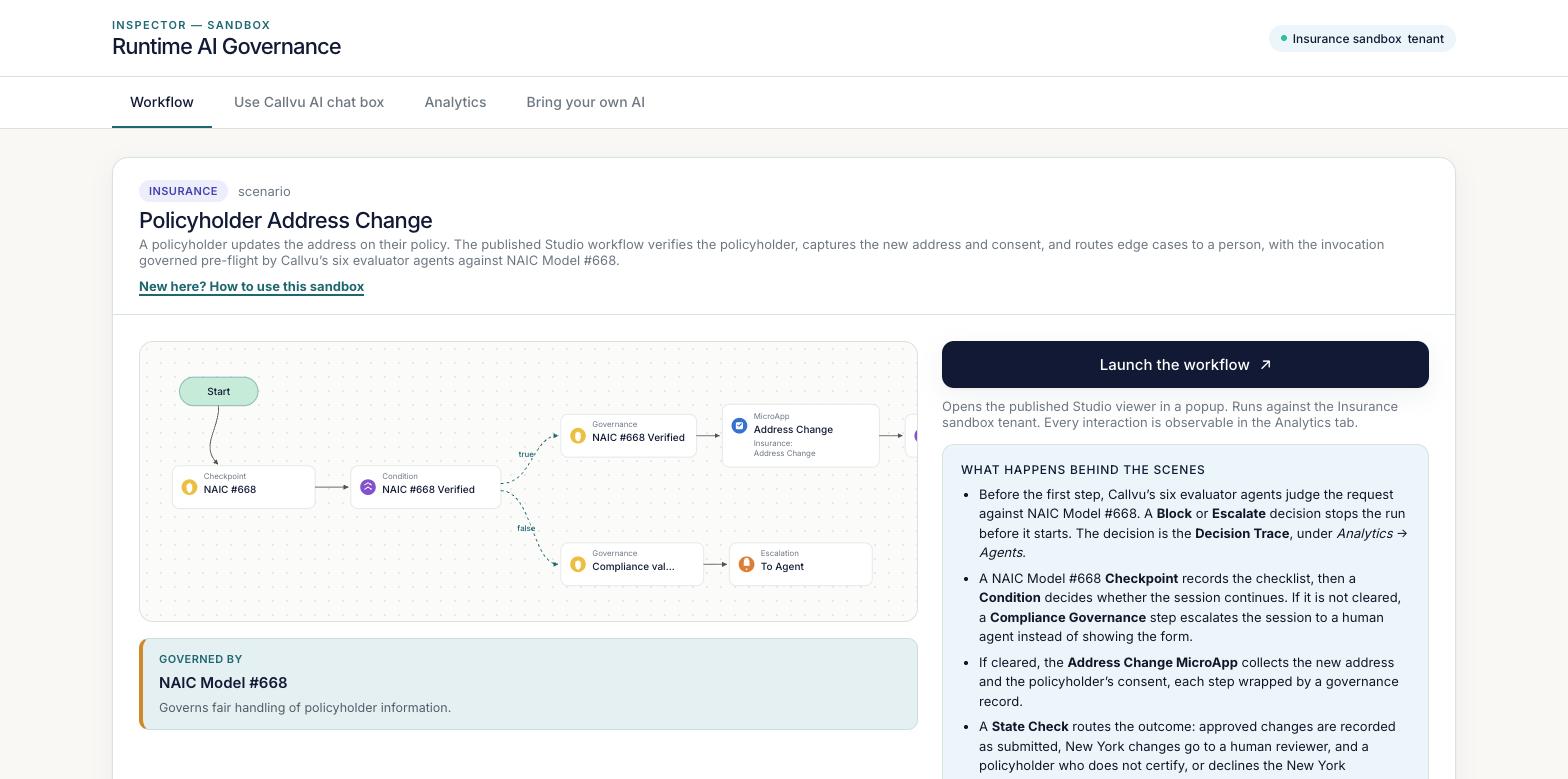
A policyholder address change, governed from the first step

The six evaluators judge the request against NAIC Model #668 before it starts. A checkpoint records the checklist. If the policyholder is not verified, the Completion Orchestrator routes the case to a person instead of continuing. Every step lands in the Decision Trace and the Audit Trace.

Sandbox: policyholder address change workflow under NAIC Model #668, with checkpoint, condition and escalation

Integrations

Runs on the systems your carrier already has

Policy admin, claims, billing, documents, CRM, contact center and messaging, plus your GRC system. By API and webhook, built to what you run. At Phoenix Insurance, every core system was integrated in 4 weeks.

See all integrations
  • Insurance Solutions
  • CXone

Calculator

What's your number?

What unfinished and non-compliant work costs insurance a year. Seven questions, about two minutes.

Calculate

Bring your messiest claims or service process

We build it, train your team and stay with you through launch and the ongoing management of your processes. You are live in weeks, with the evidence your regulators ask for.

Talk to an insurance expert