
Platform · Runtime enforcement
Compliance enforced while the work runs.Not reviewed after the fact.
Traditional BPM suites monitor compliance after the fact. Callvu checks every request before its first step and every step as it runs, against the regulation and your own policies. A missing disclosure, a skipped identity check or incomplete evidence stops the run.
- AI evaluatesSix agents judge every request and every step. They advise.
- Deterministic systems executeThe Orchestrator runs the work, the same way every time.
- Humans governYou set the guardrails. People decide in the Decision Desk.
Watch · 0:59
Runtime enforcement,in under a minute.
Six evaluators, one decision, and a run that cannot finish unless every rule is met.
Read the transcript
Most companies check compliance after the fact. When something was missed, they go back and redo it by hand. Callvu enforces compliance while the work runs. Before the first step, and at every step, six AI evaluators judge the request: policy, risk, data trust, evidence, audit readiness and exception patterns. They advise. They never execute. The Completion Orchestrator weighs their signals against your guardrails and makes one decision. Execute. Execute with safeguards. Escalate to a person in the Decision Desk. Or block. A run that breaks a rule never reaches the end. So if it completed, it was compliant. Every run produces a Decision Trace and an Audit Trace, immutable, and pushed to your GRC in real time. AI evaluates. Deterministic systems execute. Humans govern.
Where compliance breaks today
Most compliance is checked after the fact.By then, the damage is done.
Checked after the fact
Audits and quality reviews find the missed disclosure months later, after the customer and the regulator are already affected.
Rules live outside the process
Regulations and SOPs sit in binders, wikis and training decks. Whether they are followed depends on who handles the case.
AI with no control point
Chatbots and AI agents take requests and make promises, with nothing enforcing what must happen before the work moves. They also hallucinate, and can write wrong data straight into your system of record.
Evidence rebuilt at audit time
Proof of who checked what, under which rule and when, is pieced together from emails and screenshots.
How Callvu enforces it
Six AI agents evaluate.One orchestrator decides.
Six AI agent evaluators check every request before its first step and every step as it runs. They advise and never execute. The Completion Orchestrator weighs their signals against the guardrails you set and makes one decision, every time.
1. The request
Address change
Customer signed in, identity verified in session
Policy in force: GLBA
2. Six AI agents evaluate. They advise.
- Policy and Rules InterpreterPass
- Completion Risk AssessorPass
- Data Trust and Source ConfidencePass
- Compliance Evidence ValidatorPass
- Audit ReadinessPass
- Exception Pattern LearnerPass
3. One orchestrator decides
Completion Orchestrator
The only thing that executes
Execute
4. The result, on the record
Written to the core. Notices sent to the old and new address.
Decision Trace and Audit Trace
evaluations 6
directive Execute
evidence captured, immutable
Six AI agent evaluators check
- 1Policy and Rules InterpreterTurns regulations and your SOPs into rules the run must follow
- 2Completion Risk AssessorScores the risk of each run, at every step
- 3Data Trust and Source ConfidenceChecks that the data in the run can be relied on
- 4Compliance Evidence ValidatorConfirms disclosures, identity checks and acknowledgments are there
- 5Audit ReadinessAsks whether the run would stand up to an audit
- 6Exception Pattern LearnerLearns from past failures and flags gaps to your governance team
The Completion Orchestrator decides, every time
Execute
Every check passes. The run goes straight through to your systems of record.
Execute with safeguards
The run continues only after a step-up, such as an extra identity check or a required disclosure.
Block
A required control is missing, so the run does not proceed. It fails closed, and the reason is recorded.
Escalate to a person
A regulatory or audit issue needs judgment. The case goes to the right reviewer in the Decision Desk, with the reason.
Live example: a real workflow
A policyholder address change,governed from the first step
Before the first step, the six evaluators judge the request against NAIC Model #668. A checkpoint records the checklist. A condition decides whether the session continues. If the policyholder is not verified, the case goes to a person instead of the form. Every step lands in the Decision Trace and the Audit Trace.
Run it in the sandbox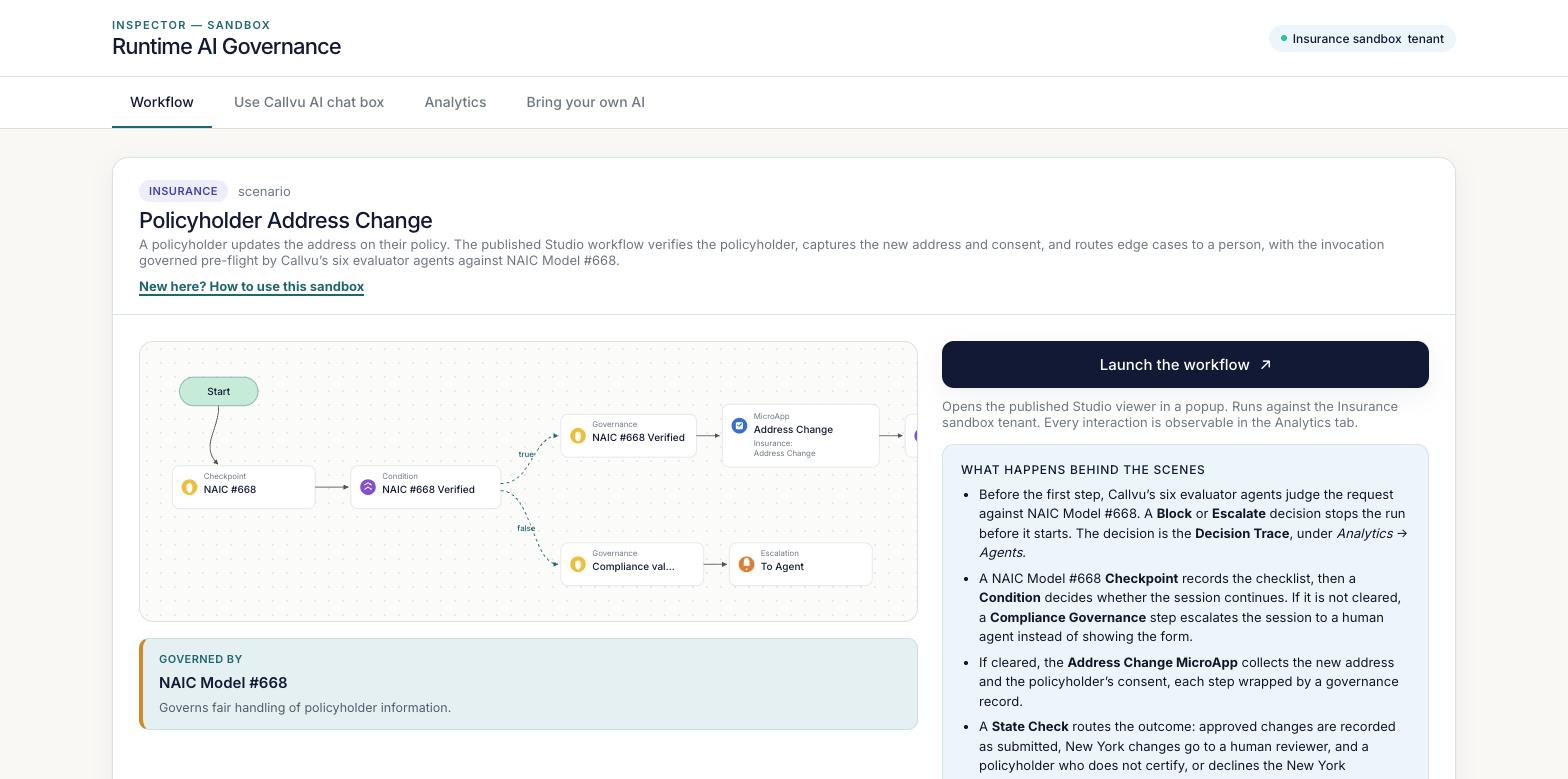
Your rules, not only the regulator's
Regulations and your SOPs,enforced the same way
Callvu Studio comes with most of the regulations already loaded as ready-to-use policies, for every industry Callvu serves. You start from a library, not a blank page. Most companies also have their own standard operating procedures on top. Callvu builds those as custom policies and enforces them exactly like any regulation.
Example: documents checked on arrival
The right document, not just a document
A borrower uploads a tax return. Callvu reads it and checks it against what this loan requires: the right form, the signatures and the dates. If it is the wrong form, the borrower is asked for the right one on the spot, not weeks later when an underwriter opens the file.
Document reading uses OCR, with the check run by the Compliance Evidence Validator.
- GLBAPreloaded
- NYDFS 500Preloaded
- FinCEN CIPPreloaded
- BSA and CDDPreloaded
- CFPB 1033Preloaded
- FCRA Red FlagsPreloaded
- Reg EPreloaded
- Reg CCPreloaded
- UDAAPPreloaded
- Your own SOPFor example: a second approver on any wire over your limitCustom
Every policy runs at runtime: checked before the first step and at every step, with the result in the Decision Trace.
Examples, not a full list.
If a rule is written down, Callvu can enforce it. A new regulation takes a non-technical person about an hour to add.
The record
Not a log file we summarized.The actual execution record.
Every run produces two records, by default, immutable and replayable for examiners.
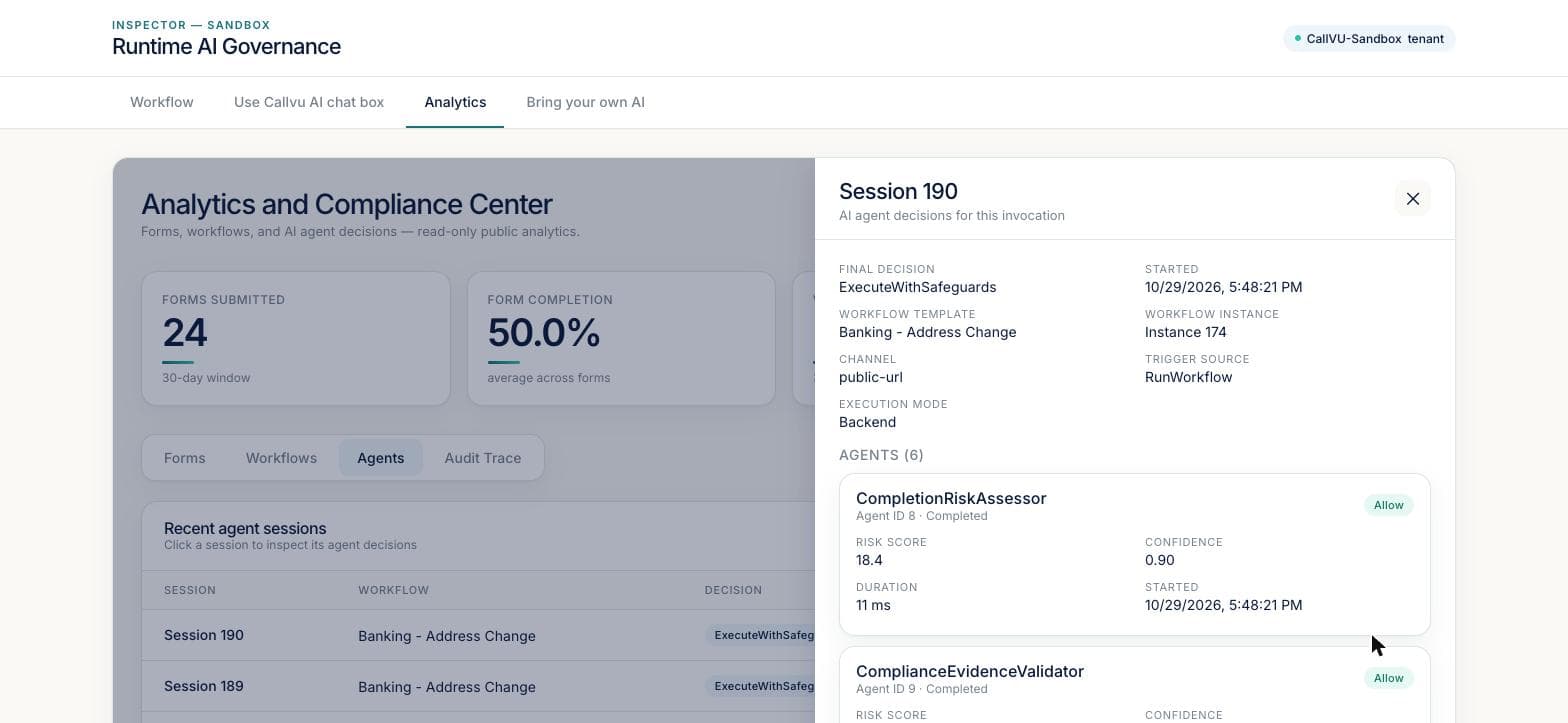
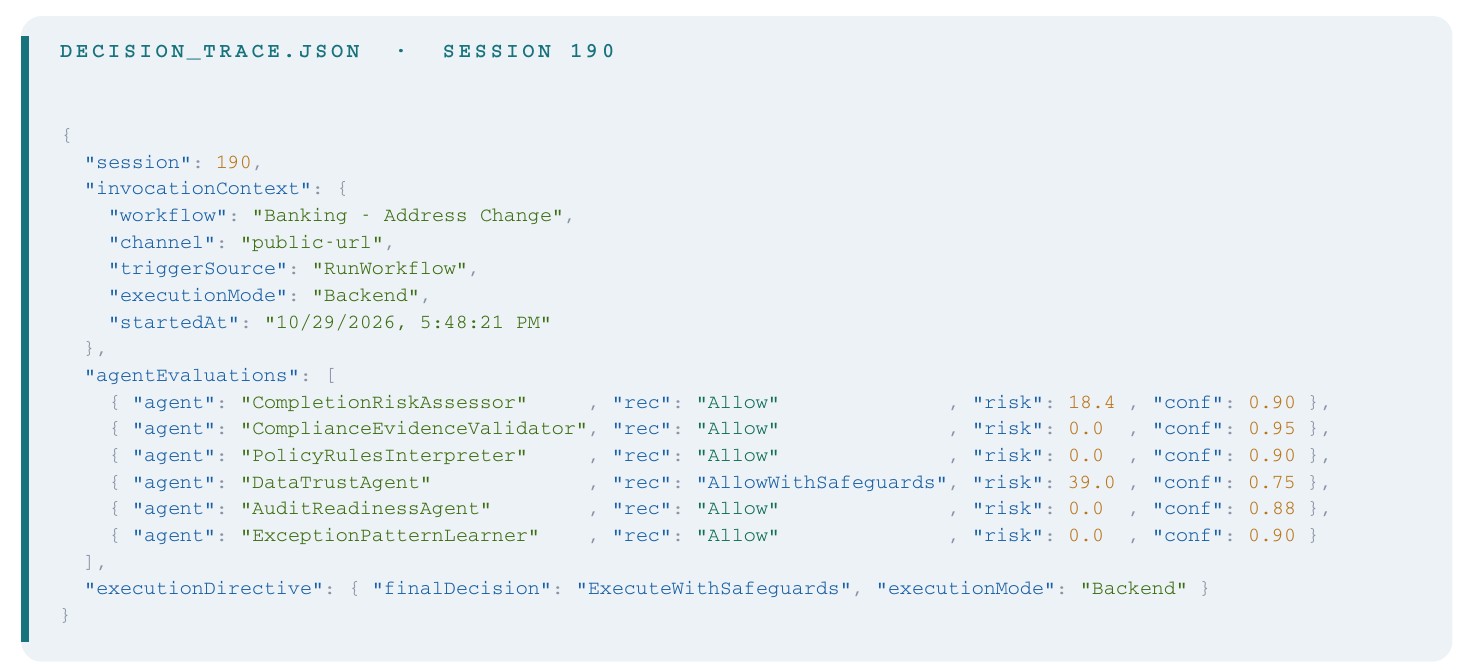
The Decision Trace shows what the AI evaluated and what the Orchestrator decided.
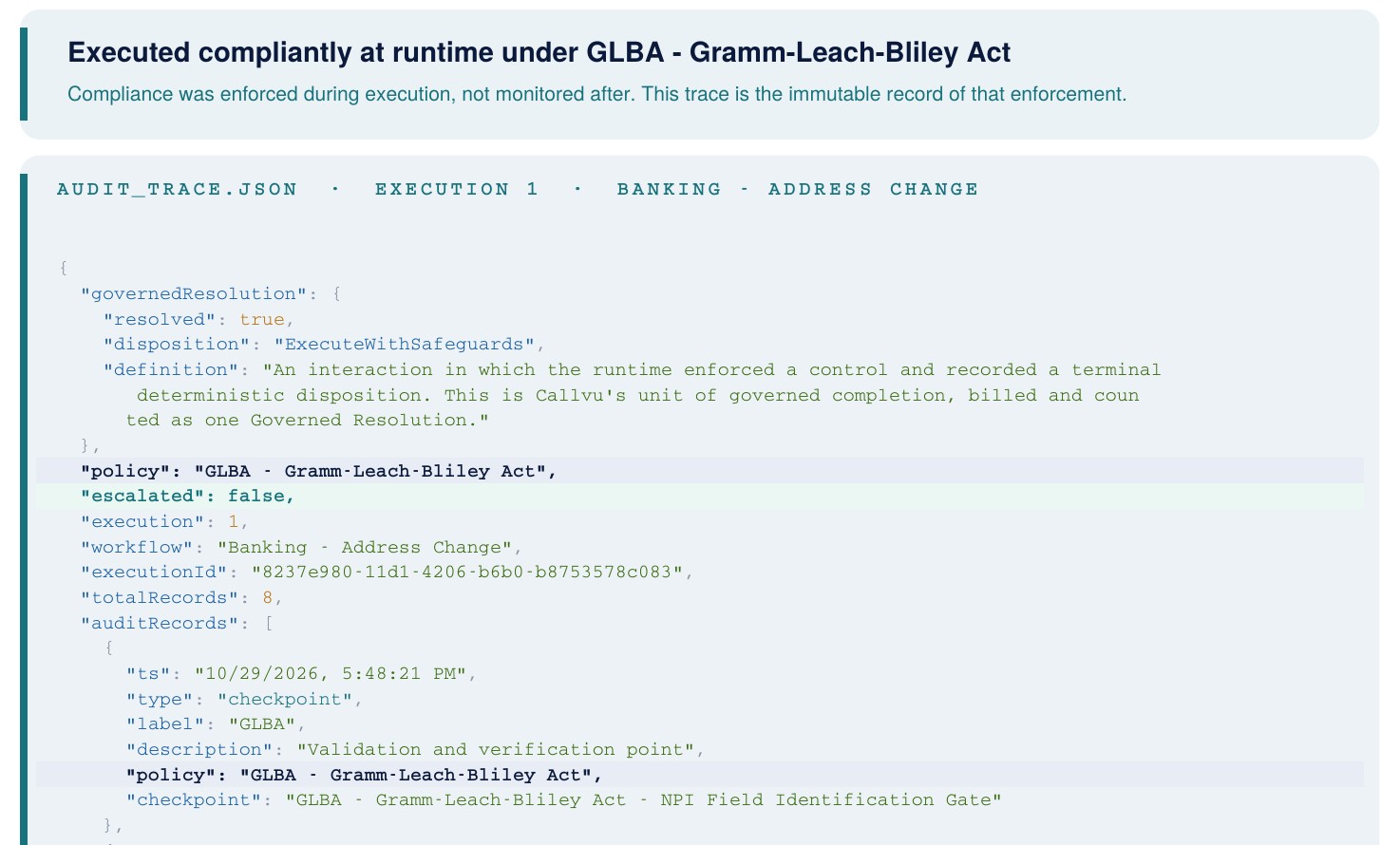
The Audit Trace shows every checkpoint, policy and escalation, in order, with a timestamp.
What triggered it
The channel, the caller and the time, down to the target workflow.
What the AI evaluated
Each evaluator's signal, confidence and reason.
What was decided
The Orchestrator's decision, the path taken and the rule version in force.
The evidence
Signatures, consents, identity checks and document hashes, time-stamped.
Real traces, not mockups
Both records above come from actual runs on the live Callvu runtime.
Sensitive data masked by policy
PHI and other sensitive fields are masked before the record goes anywhere else.
Straight into your GRC and BI
Every trace is pushed in real time to your GRC and BI tools through the Callvu Analytics API, so your auditors work in the tools they already use.
Three ways to execute, with any AI or none
Your AI describes the intent.Callvu controls the execution.
The channel changes. The compliance contract does not. The same enforcement and the same record apply whether the request comes from Callvu AI, your own AI agent, a contact center or a web form.
Guided execution
- A customer or an agent completes the process on a screen the process controls: a web page, an app, a link or the contact center desktop.
- Every step is enforced and none can be skipped. A missing disclosure, a skipped identity check or incomplete evidence fails the run closed.
- Known data is prefilled from your systems and results are written back by API, with every step in the Decision Trace and the Audit Trace.
When to use
High-touch, high-risk completions, and any step that needs sensitive data: onboarding, KYC, payment authorization, signatures.
Example: A banking address change with disclosure capture
Backend execution
- Callvu AI or your own AI agent starts the governed process over MCP. There is no screen for the customer.
- The AI describes the intent. Callvu decides what may run, runs it deterministically and writes the result to your systems of record.
- Same enforcement, same Decision Trace and same Audit Trace as a run started from a link or a guided screen.
When to use
When the process needs no sensitive information as input. Sensitive data never goes into an AI chat, whether it is Callvu AI or your own agent.
Example: An AI agent hands a claim assignment to Callvu over MCP
Hybrid execution
- The AI starts the governed process itself and carries what you told it into the run.
- Steps that must not be skipped, such as consent and signature, stay on a screen the process controls. The chat hands you that screen with your answers already in it.
- Conversation where it helps, a controlled screen where it matters, one workflow underneath, recorded the same way as a run started from a link or by an agent.
When to use
The most common enterprise pattern: an AI conversation up front, with sensitive steps on a controlled screen.
Example: First notice of loss: the chat opens the claim, the customer gives consent and uploads damage photos on screen
Already have a conversational AI?
It describes the intent. Callvu controls the execution. They work together: your AI calls Callvu over MCP.
Already have a workflow platform?
Traditional BPM suites check compliance after the fact. Callvu enforces it while the work runs. A different architecture, not a missing feature.
By industry
Runtime enforcement acrossseven industries.
The regulations change by industry; the enforcement does not. One page per industry, each with twelve processes and the rules and clocks enforced while they run.
Banking and credit unions
A bank's compliance is still checked after the fact: the Reg E dispute clock starts on a call nobody dated, the Reg DD notice goes out after the change hits the core, and the examiner rebuilds the evidence from emails.
Runtime enforcement across banking
Home lending
Lenders and servicers miss the TRID three-business-day clock, the Reg B 30-day notice and the Regulation X loss mitigation deadlines because the rules sit in a binder while the file moves between teams by email.
Runtime enforcement across home lending
Insurance
Insurers are examined on what happened inside the work: whether the claim was acknowledged inside the state's period, whether the HIPAA authorization came before the medical questions, whether the non-renewal notice went out with the state's days and reasons, whether every payee was screened before the payment, and most of that is checked months later from files.
Runtime enforcement across insurance
Healthcare
Hospitals and health plans still take consents on paper in pre-op, release records against expired authorizations, and find out at the audit that the good faith estimate went out late or the payer's decision window has passed.
Runtime enforcement across healthcare
Telecom
Port-outs, PIN resets, unlocks, plan changes and deposits are approved on calls with questions a fraudster can answer, and each channel applies its own checks while the FCC's notification, one-business-day porting and two-business-day separation rules run.
Runtime enforcement across telecom
Utilities
Utilities get disconnection, deposit and billing rules wrong when the rule lives in a binder and the agent, the shutoff list or the billing run does not read it.
Runtime enforcement across utilities
Travel and eCommerce
A cancelled flight, a baggage claim, a missing parcel, a chargeback, a tax exemption certificate or a deletion request each carries a rule and a deadline, from the DOT's seven business days for a card refund to the CCPA's forty-five days for a response, and today each is checked after the fact, if at all.
Runtime enforcement across travel and eCommerce
Enforcement runs through the whole handoff
From the request to the system of record, with nobody re-keying.
Guide
Compliance at runtime, explained
How a required step becomes one that cannot be skipped, and what the examiner sees.
Bring the process your auditors worry about most
We build it, train your team and stay with you through launch and the ongoing management of your processes. You are live in weeks.