The Completion and Compliance Layer for healthcare providers

The procedure is booked.The paperwork is not.

Intake, prior authorization, consent and estimates still move by fax, phone and re-keying between the patient, the payer and the EHR, while the procedure date gets closer. Callvu runs each one from the first contact to the EHR, and enforces HIPAA and your own policies at runtime, while the work happens. Live in weeks.

Healthcare rules, preloaded

  • HIPAA
  • No Surprises Act
  • CMS prior authorization

At the Ministry of Health hospital network

Four lines of business

Where it breaks today,and where to start

Patient intake and pre-procedure steps

Where it breaks today

  1. Pre-procedure questions, insurance details and history are collected by phone and re-typed into the EHR.
  2. Patients fill in the same forms at every visit, on paper or a clipboard.
  3. Missing items surface on the day of the procedure, and the case is pushed back.

What Callvu enforces, on the record

  1. The patient gets a text or link with the booking already filled in from the EHR, and only answers what is missing.
  2. The procedure type decides the questions and the documents. Nothing incomplete reaches the surgical team.
  3. Answers are written straight to the EHR, with every step in the Audit Trace.
  4. Written to your system of record, with the Decision Trace and Audit Trace

Where a typical provider struggles most:

  • Pre-surgery intake
  • Insurance verification
  • Pre-procedure document collection

Proof: The Ministry of Health hospital network eliminated 1M+ pages of paper

Talk to a healthcare expert

Prior authorization

Where it breaks today

  1. Authorization requests go to the payer by fax and portal, and status is chased by phone.
  2. A missing clinical note or form stops the request until someone calls the clinic.
  3. Nobody can see which procedures are at risk until the date is close.

What Callvu enforces, on the record

  1. The request is built from the EHR order, with the payer's required documents checked before it is sent.
  2. Missing items are chased from the clinic or the patient, on a clock tied to the procedure date.
  3. Approvals and denials are written back to the EHR, and cases at risk go to a person in the Decision Desk.
  4. Written to your system of record, with the Decision Trace and Audit Trace

Where a typical provider struggles most:

  • Scheduled-procedure prior authorization
  • Payer document requests
  • Authorization renewals

Proof: The Ministry of Health hospital network approves procedures 3x faster

Talk to a healthcare expert

Consent and patient authorizations

Where it breaks today

  1. Surgical consent is signed on paper on the day, and sometimes is not on file at all.
  2. HIPAA authorizations and release forms live in different systems.
  3. Proving who consented to what, and when, means pulling the paper chart.

What Callvu enforces, on the record

  1. Consent is completed ahead of time on a screen the process controls, with the required disclosures shown first.
  2. Identity is verified before signature, and nothing is skipped.
  3. Signed consent goes to the EHR with who signed, what they saw and when.
  4. Written to your system of record, with the Decision Trace and Audit Trace

Where a typical provider struggles most:

  • Surgical consent
  • HIPAA authorizations
  • Release of information requests

Proof: The Ministry of Health hospital network completes patient consent 78% faster

Talk to a healthcare expert

Estimates and patient financial clearance

Where it breaks today

  1. Good faith estimates are built by hand and sent late, or not at all.
  2. Patients learn their share after the procedure, and payment plans are set up by phone.
  3. Financial assistance applications arrive incomplete and wait in a queue.

What Callvu enforces, on the record

  1. Good faith estimates go out on the No Surprises Act clock, from the booking.
  2. Patients see their share, choose a payment plan and pay on a secure screen before the date.
  3. Assistance applications are complete before review, and the decision goes back to patient billing.
  4. Written to your system of record, with the Decision Trace and Audit Trace

Where a typical provider struggles most:

  • Good faith estimates
  • Patient payment plans
  • Financial assistance applications

Proof: 23 hospitals in the Ministry of Health network run their patient processes on Callvu

Talk to a healthcare expert

See it under HIPAA

A pre-surgery intake, governed from the first step

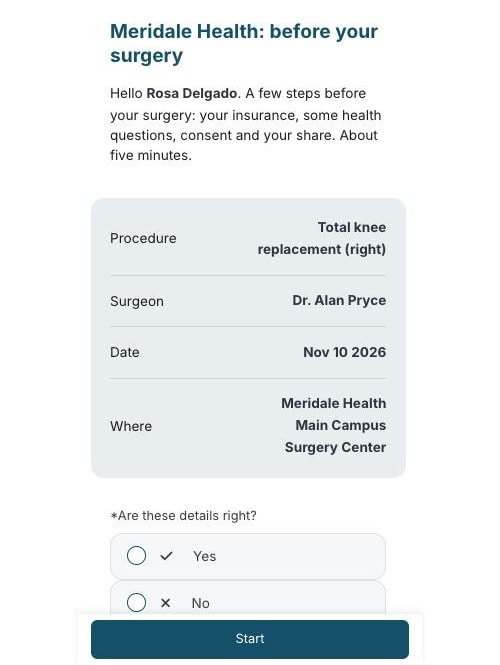
The patient gets a text with the booking already filled in from the EHR: the procedure, the surgeon, the date and the place. They confirm it, answer the health questions, sign consent and see their share. HIPAA masks the member ID before the eligibility check leaves for the payer. Every step lands in the Decision Trace and the Audit Trace.

A patient's pre-surgery intake on a phone, with the booking prefilled from the EHR

Integrations

Runs on the systems your hospital, clinic or practice already has

The EHR, payer portals, scheduling, patient billing, contact center and messaging, plus your GRC system. By API and webhook, built to what you run. Sensitive data is masked by policy before it leaves.

See all integrations
  • Health (Millennium)
  • CXone

Calculator

What's your number?

What unfinished and non-compliant work costs healthcare a year. Seven questions, about two minutes.

Calculate

Bring the process patients wait on most

We build it, train your team and stay with you through launch and the ongoing management of your processes. You are live in weeks, with the evidence your compliance team asks for.

Talk to a healthcare expert