
Platform · The handoff
Every regulated process has a handoff.That is where cost and risk live.
Taking the request is the easy part. What comes next is the re-keying, the chasing, the approvals and the clock. Callvu runs that handoff end to end, between your front office and your back office.
Front office · where requests start
The handoff today
EmailPDFRe-keyPhone tagSpreadsheetSticky noteBack office · where work gets done
Watch · 0:47
The handoff,in under a minute.
Today versus with Callvu: the application, the documents, the routing and the clock, and a back office that sees the week from minute zero.
Read the transcript
Taking the request is the easy part. The handoff is where it breaks. Today, a loan application arrives. Documents come back by email. Someone re-keys them. The back office finds out days later, and by Thursday, everything lands at once. With Callvu, the handoff runs as one governed process. The application is prefilled from your core. Documents are read and checked the moment they arrive. The work is routed to the right skill, with a due date. And the back office sees it at minute zero. Thursday's work is visible on Monday, so Thursday is staffed on Monday. One governed run, from the front office to the back office. Every step on the record.
Where your regulated workflow breaks today
The front door got faster.The back office did not.
Whether the request starts at a contact center, in a branch, a store or a clinic, on paper, in a digital form or with an AI agent, the work behind it still runs on email, PDFs and phone calls.
Today, without Callvu
- Day 0Request arrives by email, portal or phone
- Day 1Sits in a shared inbox
- Day 2Re-keyed into the system of record
- Days 3 to 6Missing document chased by phone
- Day 7Decision made over email
- Day 8Back office finds out and plans staff
With Callvu
- Minute 0Request arrives, prefilled from your systems
- Minute 0Classified by skill and due date. Back office sees it
- Day 1Missing document requested and checked
- Day 2Decision made in the Decision Desk
- Day 2Written back. Every step on the record
Data typed in multiple times
The customer fills in a form, then people re-key it into the core, the CRM, the EHR and every other system that needs it. Every re-key is a delay and a chance for an error.
Work lands in one or more inboxes
Requests sit in shared mailboxes with no owner, no skill tag and no due date, while the regulatory clock is already running. With no owner, there is no accountability to enforce.
Outside parties chased by hand
Documents from borrowers, hospitals, credit bureaus, third parties and suppliers are requested by email and phone, with nothing measuring the wait.
Decisions with no record
Approvals happen in email threads and hallway conversations, and rarely reach the system of record on time or accurately. At audit time, the evidence is rebuilt by hand.
How Callvu fixes it
Five automated steps.One governed process.
The same five steps run whether the request came from a branch, a web form, a call center or an AI agent.
Prefill
Callvu reads what your systems already know, from the CRM, the core or the EHR, and prefills the form. The customer only answers what is missing.
Classify
The request becomes a unit of work the moment it lands: work type, skill needed, effort and due date.
Chase and verify
Missing documents are requested from the right party on a clock. On arrival, Callvu checks each one against what the case needs: the right form, signatures and dates.
Decide
When a person has to decide, the case goes to the right reviewer, inside or outside your company, in the Decision Desk, with only the allowed choices. Nudges go out by email or text.
Write back
The result goes straight into your system of record by API, with the full record of who did what, when and why.
What you get
Guided, step-by-step completion
Nothing skipped, nothing re-keyed
Policy checks and approvals built in
The same way every time
Connected to your systems
Front office, back office, internal
Audit trail by default
Every step, every decision, provable
The unit of work
Every request becomes work your back office team can plan
Today, the back office only sees the work after the manual steps are done: the form re-keyed, the inbox sorted, the documents chased. By then, days or even weeks are gone.
With Callvu, back office planning starts the moment the front office does.
As soon as a customer starts a loan application, a claim or an intake, Callvu knows the work type, the skill it needs, the effort and the due date. Your team can staff for it before it lands.
You set the work types, skills, effort and clocks. Your workforce tool decides who takes the work. Callvu tells it what the work is and when it is due.
You define the unit of work
Every request becomes a work item the moment it lands. You set the work types, the skill each one needs, the effort and the clock. Your back office report is built from them through the Analytics API. Example, an auto insurer:
| Work type | Skill needed | Effort | Due in |
|---|---|---|---|
| Injury | Bodily injury adjuster | 90 min | 3 days |
| Third party | Liability adjuster | 60 min | 5 days |
| Total loss | Total loss specialist | 75 min | 4 days |
| No injury | Physical damage | 30 min | 7 days |
| Legal review | Claims counsel | 120 min | 10 days |
Illustrative values. Each customer sets its own, in any industry. The skill is a role, not a person: your workforce tool decides who takes it.
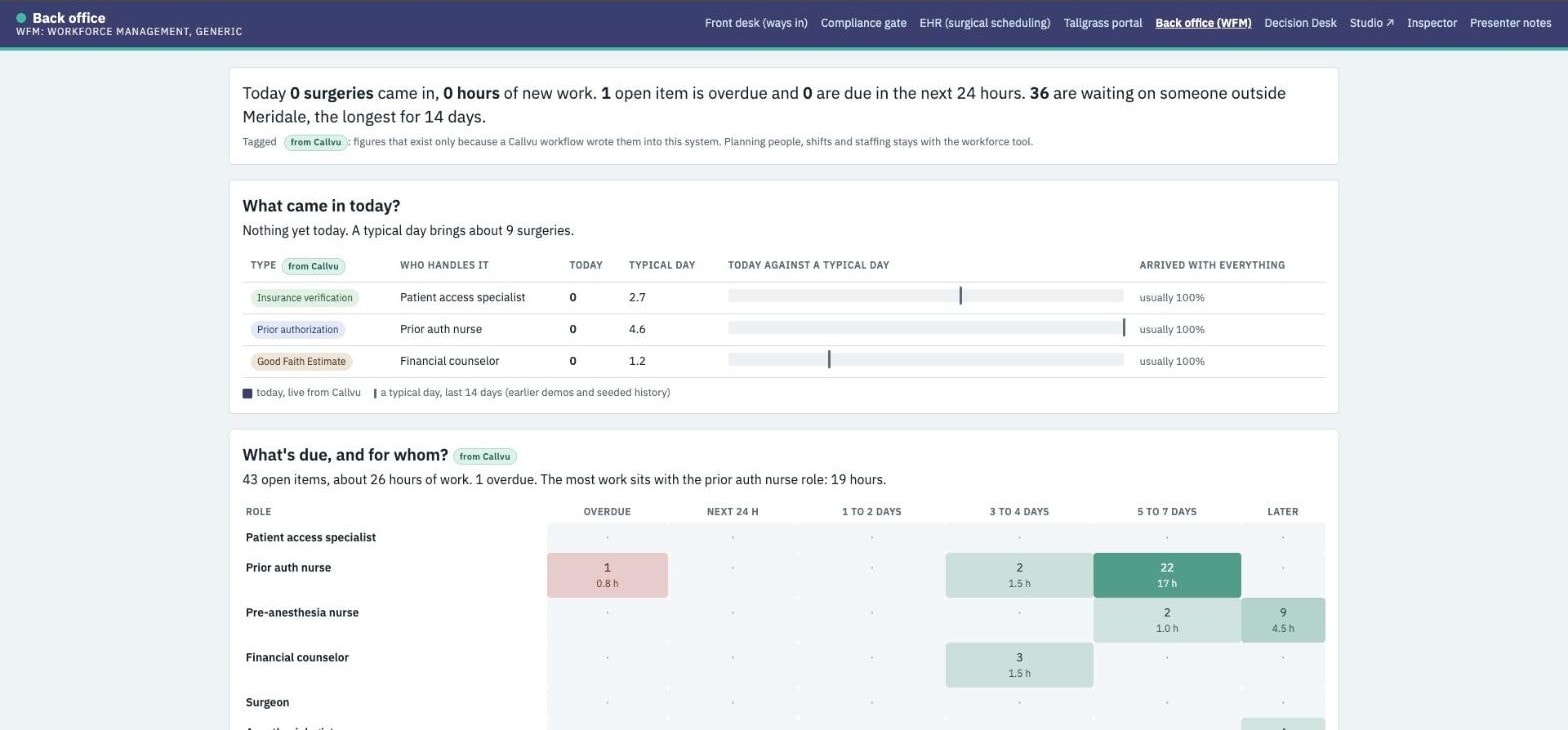
The back office view
One live view of the work
- What came in today, by work type and channel
- What is due, and for whom
- What is stuck, and on whom
- Who did the work, and how long it took
- The skills you need to staff, and when
Built to your workforce model
You choose what Callvu sends to your back office WFM: which fields, which work types, which events and in what format. Callvu fits the way your team already plans, not the other way around.
The Decision Desk
People decide.Callvu keeps the record.
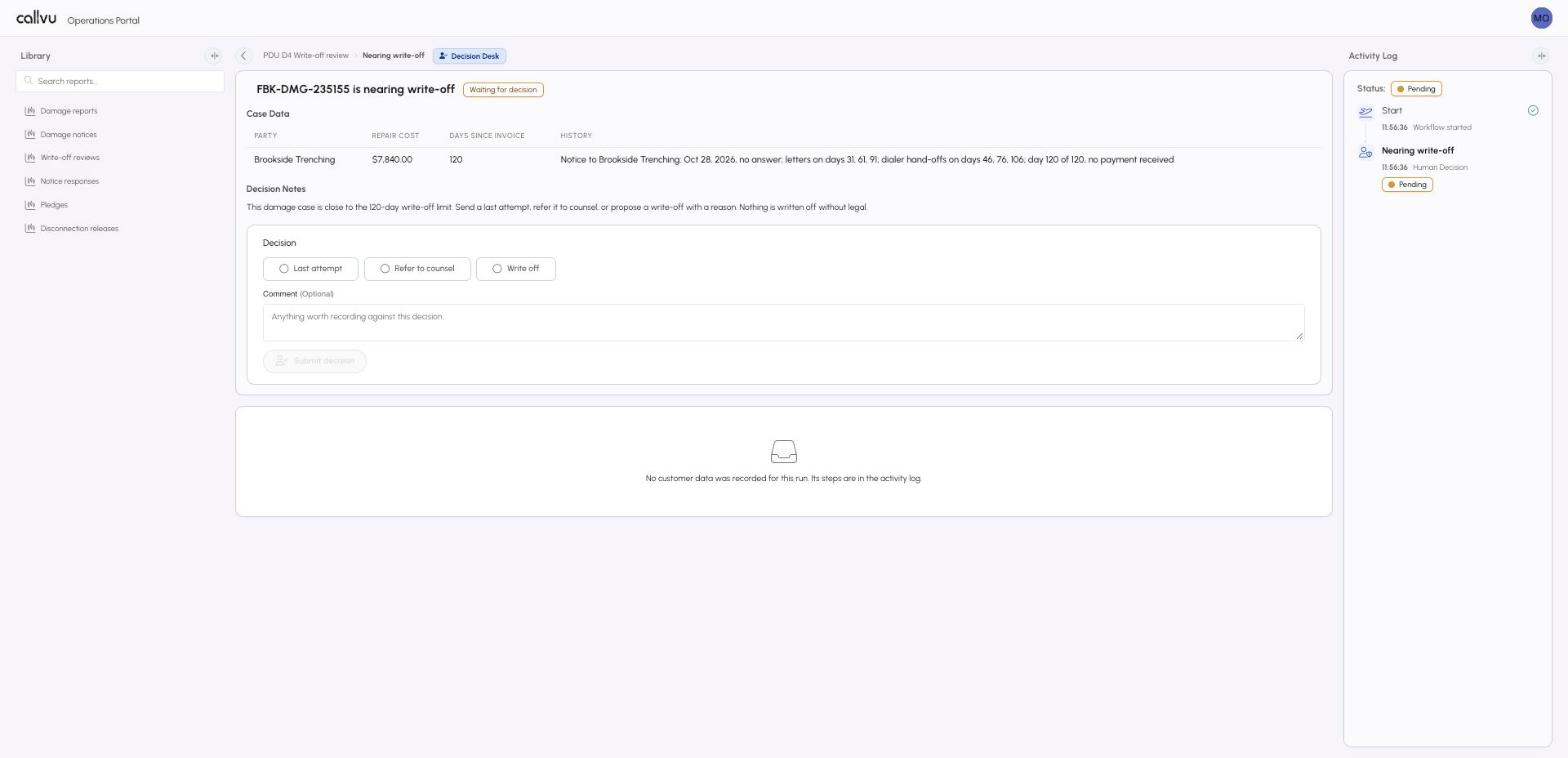
Some steps need judgment: a write-off, an exception, a large wire, a medical review. Callvu routes each one to the right decision maker in the Decision Desk, whether that is someone on your team or an outside party, such as a broker, a physician, a supplier or a partner bank. Callvu nudges them by email or text until they act. In the Decision Desk they see the full case and only the choices your policy allows.
Who decided, what they saw, what they chose and when is written to the record, and the process continues on its own.
CLM-20418 · Storm damage
New · due in 2 days- Photos of the damage (2)
- Signed statement
- Photo of the meter
Your choices under policy
Report storm damage
Signed · Dana Lee
SubmitCustomer portal
On the recordEvery request, upload and check, with who and when
What a governed handoff delivers
Every step of the handoff is enforced at runtime
Six AI agent evaluators check each step against the regulation and your own policies before it runs.
Guide
The handoff
Why work breaks between the front office and the back office, and how to run it end to end.
Bring your messiest handoff
We build it, train your team and stay with you through launch and the ongoing management of your processes. You are live in weeks.